


Towing


Thread Starter
Junior Member
Joined: Oct 2019
Posts: 29
Likes: 1

Update: Good news! Called for they said I have the 3.5l EcoBoost with max tow package. I "can" tow up to 18,400 lbs, and my max hitch weight is 1346 lbs. The 500 lb hitch weight is the a regular 150 with the max tow package. Whew!! I didn't want by a new truck. I verified it by looking on the hitch itself. I just needed Ford to clarify. I weighed my tongue weight and it is 1,150 lbs. I am golden, even with my atv in it. Thank you Lord.

Grumpy Old Man
Joined: Nov 2011
Posts: 3,129
Likes: 887
From: Midland County Texas, just west of the star in my avatar
What the dealership and the advertisements do not tell you is that there is only a max tow hitch rating of 500 lbs.
As you know by now, that’s with a weight-carrying hitch = either the ball mount in the step bumper or a simple shank with ball mount in the receiver. But with a weight-distributing hitch (WDH), the tongue-weight (TW) rating of your receiver increases to 1,320 pounds. That’s a normal tandem-axle trailer that grosses up to about 10,000 pounds without overloading the hitch.
But the hitch is not your limiter as to how heavy a trailer you can tow without being overloaded. Payload capacity available for hitch weight is your limiter. Your payload capacity available for hitch weight is probably going to limit your max travel trailer (TT) weight to a lot less than 10,000 pounds, and probably to less than the 9.500 pounds of your toy hauler.
And ignore that GCWR and tow rating. They are extremely misleading. You can tow a 12k trailer without being overloaded only if the trailer is a wagon-style trailer with only a few pounds of hitch weight. And the wet and loaded F-150 cannot weigh more than 5,700 pounds including hitch weight. (18,400 GCWR minus 12.700 tow rating).
Because you already have the F-150 and trailer, then no need to go through all the work spelled out after this paragraph. Just load the truck and trailer for towing, fill up with gas, and weigh the rig on a CAT scale. Add the weights on the front (steer) an rear (drive) axles to get GVW, then compare GVW to GVWR. If GVW exceeds GVWR, you're overloaded.. Not the hitch, but the payload capacity of the F-150.
So to get a good estimate of the max trailer weight you can tow without being overloaded, you have to do some work. You won’t find the answer for YOUR F-150 online or any of Ford’s Owner’s Guides or towing guides. Because nobody knows how much your wet and loaded F-150 weighs.
You must determine the payload capacity available for towing, then use simple math to convert that number to trailer weight. Here’s how to get it:
1] Load the F-150 with everybody and everything that will be in it when towing. Everything! Tools, toys, campfire wood, dirty sooty Dutch oven, jacks and jack stands, portable generator and gas for the generator. If it might be in the F-150 and not in the trailer, then include it in the F-150 when you weigh the F-150.
2] Drive to a truck stop that has a CAT scale and fill up with gas. Then weigh the wet and loaded F-150.
3] Subtract the wet and loaded weight of the F-150 from the GVWR of the F-150 to get payload capacity available for hitch weight.
4] Subtract 100 pounds for a good WDH from the payload capacity available for hitch weight to get payload capacity available for tongue weight (TW). “Good” WDH include Equal-I-Zer, Blue Ox SwayPro and Reese Strait-Line Trunnion – not any of the less-expensive hitches.
5] Divide the payload capacity available for TW by 13% to get max trailer weight of a properly-loaded TT with average TW.
I can tell fairly certain that if your tow hauler weighs 9,500 pounds, you're going to overload your F-150. Not the hitch, but the payload capacity. Your properly-loaded TW is going to be about 1,235 pounds, and you probably don't have that much payload capacity available for TW.
Last edited by smokeywren; Oct 29, 2019 at 01:46 PM.


Senile member
Joined: Jun 2017
Posts: 3,633
Likes: 1,058
From: Sarasota, FL area
Update: Good news! Called for they said I have the 3.5l EcoBoost with max tow package. I "can" tow up to 18,400 lbs, and my max hitch weight is 1346 lbs. The 500 lb hitch weight is the a regular 150 with the max tow package. Whew!! I didn't want by a new truck. I verified it by looking on the hitch itself. I just needed Ford to clarify. I weighed my tongue weight and it is 1,150 lbs. I am golden, even with my atv in it. Thank you Lord.
Oy. There's so much wrong here.
First, you can't tow 18,000lbs. Period. Second, the max hitch weight is on the sticker on your hitch. It says max hitch weight without WDH is 500lbs.
Third, what you CAN tow is depending on tongue weight and your payload capacity. Tongue weight of a TT=13-15% of LOADED trailer weight.
Payload capacity? That's the number on your door sticker that says 'Cargo carrying capacity'. If your tongue weight, plus 100lbs for WDH, plus the weight of ALL occupants and cargo in the truck exceeds the payload, guess what? You've exceeded the GVWR of the truck.
Fourth, you'll pop some or many ratings before hitting a GCVWR number.
You're either ignoring everything we're telling you, or just looking for someone to tell you what you want to hear.....because I think you either bought the wrong truck for your trailer, or you bought too much trailer for your truck.


5 Year Member


Joined: Feb 2019
Posts: 2,645
Likes: 1,341
As you know by now, that’s with a weight-carrying hitch = either the ball mount in the step bumper or a simple shank with ball mount in the receiver. But with a weight-distributing hitch (WDH), the tongue-weight (TW) rating of your receiver increases to 1,320 pounds. That’s a normal tandem-axle trailer that grosses up to about 10,000 pounds without overloading the hitch.
But the hitch is not your limiter as to how heavy a trailer you can tow without being overloaded. Payload capacity available for hitch weight is your limiter. Your payload capacity available for hitch weight is probably going to limit your max travel trailer (TT) weight to about 7,000 to 8,000 pounds
And ignore that GCWR and tow rating. They are extremely misleading. You can tow a 12k trailer without being overloaded only if the trailer is a wagon-style trailer with only a few pounds of hitch weight. And the wet and loaded F-150 cannot weigh more than 5,700 pounds including hitch weight. (18,400 GCWR minus 12.700 tow rating).
So to get a good estimate of the max trailer weight you can tow without being overloaded, you have to do some work. You won’t find the answer for YOUR F-150 online or any of Ford’s Owner’s Guides or towing guides. Because nobody knows how much your wet and loaded F-150 weighs.
You must determine the payload capacity available for towing, then use simple math to convert that number to trailer weight. Here’s how to get it:
1] Load the F-150 with everybody and everything that will be in it when towing. Everything! Tools, toys, campfire wood, dirty sooty Dutch oven, jacks and jack stands, portable generator and gas for the generator. If it might be in the F-150 and not in the trailer, then include it in the F-150 when you weigh the F-150.
2] Drive to a truck stop that has a CAT scale and fill up with gas. Then weigh the wet and loaded F-150.
3] Subtract the wet and loaded weight of the F-150 from the GVWR of the F-150 to get payload capacity available for hitch weight.
4] Subtract 100 pounds for a good WDH from the payload capacity available for hitch weight to get payload capacity available for tongue weight (TW). “Good” WDH include Equal-I-Zer, Blue Ox SwayPro and Reese Strait-Line Trunnion – not any of the less-expensive hitches.
5] Divide the payload capacity available for TW by 13% to get max trailer weight of a properley-loaded TT with average TW. I can tell fairly certain that if your tow hauler weighs 9,500 pounds, you're going to overload your F-150. Not the hitch, but the payload capacity. Your properly-loaded TW is going to be about 1,235 pounds, and you probably don't have that much payload capacity available for TW.
Because you already have the F-150 and trailer, then no need to go through all that work. Just load the truck and trailer for towing, fill up with gas, and weigh the rig on a CAT scale. Add the weights on the front an rear axles to get GVW, then compare GVW to GVWR. If GVW exceeds GVWR, you're overloaded.. Not the hitch, but the payload capacity of the F-150.
Thread Starter
Junior Member
Joined: Oct 2019
Posts: 29
Likes: 1
Thank you smokeywren for that good info. My trailer only weighs 9500 lbs and some change. I will go and get the truck weighed after filling up the tank, then I will get the weight of the truck and loaded trailer. Will the CAT scale show me the individual weight of the truck and trailer axles at one time? Since my trailer weighs 9,500 lbs, do you still think I am overloaded, with the max weight rating on the hitch is 1,376 lbs and my tongue weight reads almost 1,100 pounds with a tongue scale. I have the 3.5l ecoboost and max tow package. These two together are supposed to tow more than an F150 without the two options. With the regular 150, the max tow is 5,000 lbs.
Your advice is strongly appreciated. Thanks for your time.in responding. I am new to all this.
Your advice is strongly appreciated. Thanks for your time.in responding. I am new to all this.

5 Year Member
Joined: Oct 2017
Posts: 633
Likes: 223
Thank you smokeywren for that good info. My trailer only weighs 9500 lbs and some change. I will go and get the truck weighed after filling up the tank, then I will get the weight of the truck and loaded trailer. Will the CAT scale show me the individual weight of the truck and trailer axles at one time? Since my trailer weighs 9,500 lbs, do you still think I am overloaded, with the max weight rating on the hitch is 1,376 lbs and my tongue weight reads almost 1,100 pounds with a tongue scale. I have the 3.5l ecoboost and max tow package. These two together are supposed to tow more than an F150 without the two options. With the regular 150, the max tow is 5,000 lbs.
Your advice is strongly appreciated. Thanks for your time.in responding. I am new to all this.
Your advice is strongly appreciated. Thanks for your time.in responding. I am new to all this.
Without knowing your payload rating there is no way anyone on this forum can tell you if with 1,100lbs of tongue weight you will be ok. What does the yellow sticker on the door jam say your payload is?
I don't mean to be a jerk, but please do a bit more research before you put close to 10,000lbs behind your truck.
Thread Starter
Junior Member
Joined: Oct 2019
Posts: 29
Likes: 1
Yeah so there is still a lot wrong here. Follow what Smokey said. Also remember that if you are putting more than 500lbs on the ball, which you are, you will need a property setup Weight Distributing Hitch. No F150 can handle more than 500lbs of tongue weight w/o a WDH.
Without knowing your payload rating there is no way anyone on this forum can tell you if with 1,100lbs of tongue weight you will be ok. What does the yellow sticker on the door jam say your payload is?
I don't mean to be a jerk, but please do a bit more research before you put close to 10,000lbs behind your truck.
Without knowing your payload rating there is no way anyone on this forum can tell you if with 1,100lbs of tongue weight you will be ok. What does the yellow sticker on the door jam say your payload is?
I don't mean to be a jerk, but please do a bit more research before you put close to 10,000lbs behind your truck.
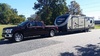
Thank you for your response. The yellow sticker says 7000 lbs. I weighed my truck and it is 5660 lbs. That leaves 1,340 for payload. That 5660 is with passengers and cargo. I have a 14,000 lb distribution hitch, which I would say would weigh 100 lbs or so. That still leaves 1,240 lbs.
I appreciate your time and expertise on this.
5 Year Member
Joined: Oct 2017
Posts: 633
Likes: 223
Thank you for your response. The yellow sticker says 7000 lbs. I weighed my truck and it is 5660 lbs. That leaves 1,340 for payload. That 5660 is with passengers and cargo. I have a 14,000 lb distribution hitch, which I would say would weigh 100 lbs or so. That still leaves 1,240 lbs.
I appreciate your time and expertise on this.
I appreciate your time and expertise on this.