


Payload question


5.0 DOHC V8 | 7.3 Gdzilla


Joined: Apr 2017
Posts: 3,987
Likes: 2,077
From: California and Utah

With such a low-trim XLT, I can place Occupants and Cargo to the tune of 2156 lbs.
Meaning, it's curb weight when built was 4644 lbs, the weight of a 1969 Ford Country Squire station wagon with a 390 cubic inch, a C6 trans and a 9-inch rear end. Boy howdy. That's light for a pickup truck.
I misspoke. I could have added Occupants and Cargo to the tune of 2156 - BEFORE - before I made any modifications to or before I added other equipment.
Case in point: Wheels and tires. Yes, they are unsprung weight, but they weigh so much on the ground and any weight scale will read that weight as what it is. Meaning: If my factory wheel/tire assembly weighed, say, 65 lbs each, and my current wheel/tire assembly weighs (55 lb tire + 25 lb wheel) 80 lbs, X 5 (a 5th wheel/tire exact same) those tires and wheels alone are an increase of (5 X 15 lbs =) 75 lbs.
One of the first accessories I purchased was a Hi Lift jack. So that's another 35 or 40 lbs right there. It adds up.
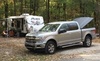
When I go down the highway and loaded for a road trip and an excursion into the southern California Mojave desert, there's extra fuel, 2 cases of water, camp stove, food, an air compressor, tools, tire repair, Hi-Lift jack winch kit, shovel, axe, kinetic rope, tow strap, tree straps, soft shackles, ****** or winch rings, etc etc etc... some precious metals in the form of copper, brass and lead, some Marlin "fishin' poles", target stands, table, chair, 10 X 10 pop up... when weighed on a Certified C.A.T. Scale my truck fully loaded w/ a full tank and just me in it weighs 5800 lbs.
I could still toss another 1000 lbs in it if I wanted.
5 Year Member


Joined: Feb 2020
Posts: 4,119
Likes: 2,261
5.0 DOHC V8 | 7.3 Gdzilla
Joined: Apr 2017
Posts: 3,987
Likes: 2,077
From: California and Utah
^ ^ ^ I haven't had enough coffee this morning to decipher that document, so I won't try (as easy or simple as it may be).

I think Ford has built enough trucks to have figured out component weights. The truck is built to a certain driveline config and then trim options and features, each of a known added weight. That number would be subtracted from any GVWR with the result being the number for "Occupants and Cargo should never exceed". Bingo.
I think Ford has built enough trucks to have figured out component weights. The truck is built to a certain driveline config and then trim options and features, each of a known added weight. That number would be subtracted from any GVWR with the result being the number for "Occupants and Cargo should never exceed". Bingo.

5 Year Member


Joined: Feb 2015
Posts: 3,512
Likes: 1,280
When I used that options list to do the calculation on my 2014 I was within 20 lbs or something of the door sticker. Its pretty close.

5 Year Member

Joined: Jun 2019
Posts: 2,728
Likes: 823
Not completely. See above. The ol’ 300 did okay for itself with less peak output when properly equipped.
Thread Starter
Senior Member

Joined: Dec 2021
Posts: 362
Likes: 151
From: Ellenton, FL
so I got more info my friends 24 STX 4x4 with 2.7 frame says 4x4HD and mine is 4x2 HD I know that a transfer case and axles dont weigh 20 lbs which is the difference in payload for 2 identical trucks I would really like to know what the deal is

Senior Member
Joined: Jan 2023
Posts: 467
Likes: 232
From: Arizona
GVWR minus curb weight equals payload. Payload is just what's leftover after the truck is finished, not a number the manufacturer tries to "hit".
Thread Starter
Senior Member
Joined: Dec 2021
Posts: 362
Likes: 151
From: Ellenton, FL
THe difference is like you said the GVWR on mine is 6426 and his is 6626 exactly 200 lbs his frame is a 4x4 HD and mine is 4x2 HD I would only assume that the 4x4 frame is the same but should if anything have more areas to add to hold in transfer case axles etc which if anything should add more weight to accommodate 300 lbs of 4x4 gear is the 4x4 frame lighter than the 2wd? or does ford just make the change on paper to make this happen
Senior Member
Joined: Jan 2023
Posts: 467
Likes: 232
From: Arizona
THe difference is like you said the GVWR on mine is 6426 and his is 6626 exactly 200 lbs his frame is a 4x4 HD and mine is 4x2 HD I would only assume that the 4x4 frame is the same but should if anything have more areas to add to hold in transfer case axles etc which if anything should add more weight to accommodate 300 lbs of 4x4 gear is the 4x4 frame lighter than the 2wd? or does ford just make the change on paper to make this happen

you can find gvwr at the top of the first sticker, it’s almost always a nice round number like you see here.

