


Hitches and ball mount drop


Senior Member


Joined: Aug 2011
Posts: 1,267
Likes: 24

Grumpy Old Man
Joined: Nov 2011
Posts: 3,129
Likes: 886
From: Midland County Texas, just west of the star in my avatar

The tow rating of 9,600 pounds is the shipping weight of the truck plus a 150-pound driver subtracted from the GCWR of the truck. If the truck is a newer F-150, then the GCWR is 15,500, and the wet and loaded pickup cannot weigh more than 5,900 pounds. But weigh your wet and loaded truck and you'll see it weighs a lot more than 5,900 pounds.
The other half of the info needed is the GVWR of the tow vehicle minus the weight of the wet and loaded tow vehicle. The answer gives you max hitch weight you can have without being overloaded. For your truck, the available payload for hitch weight is probably your limiter for trailer weight. "Normal" TT hitch weight is 12 percent of the trailer's total weight. So divide the available payload by 0.12 to get the max trailer weight you can tow without being over the GVWR of your tow vehicle. Since your truck doesn't have the higher GVWR of the max tow pkg or HD payload pkg, then hitch weight is probably your limiter, and the max trailer weight you can tow without being overloaded is a lot less than 9,600 pounds.

5 Year Member
Joined: Feb 2011
Posts: 2,582
Likes: 486
From: Maine
I've been looking at the numbers pretty closely myself as we will likely be upgrading from a popup either next year or the year after.
From what I can tell, the tow rating factors in a wet truck and 150lb driver. Payload factors in a wet truck, leaving the rated capacity for cargo and occupants.
Either way, unless you are alone and skinny, you're not towing anywhere near the rated amount without going over payload or GCWVR.
FWIW, a full tank of gas weighs around 200lb.
From what I can tell, the tow rating factors in a wet truck and 150lb driver. Payload factors in a wet truck, leaving the rated capacity for cargo and occupants.
Either way, unless you are alone and skinny, you're not towing anywhere near the rated amount without going over payload or GCWVR.
FWIW, a full tank of gas weighs around 200lb.

Senior Member
Joined: Jun 2010
Posts: 541
Likes: 23
From: Dallas, TX
Well, you were right about the cargo capacity. I'm floored with what I found. 1091 is my limit. That doesn't even begin to make sense. If the truck is "rated" at towing 9600lb, and the tongue weight is generally 10% that's 960 right there. that leaves me with 130 lbs worth of driver not to mention gas.
more typically what I'm now concerned with is my situation. My trailer has about a 600lb tongue. I usually have around 600lb of passengers including driver? How is the rating so low?
I should also say I have never felt like I've been bottoming out, or over any limit. I'm just more trying to get a grasp on these numbers.
Below are the pics from my truck for reference. it's a 2010 plat 4x4 screw
I appreciate the help.
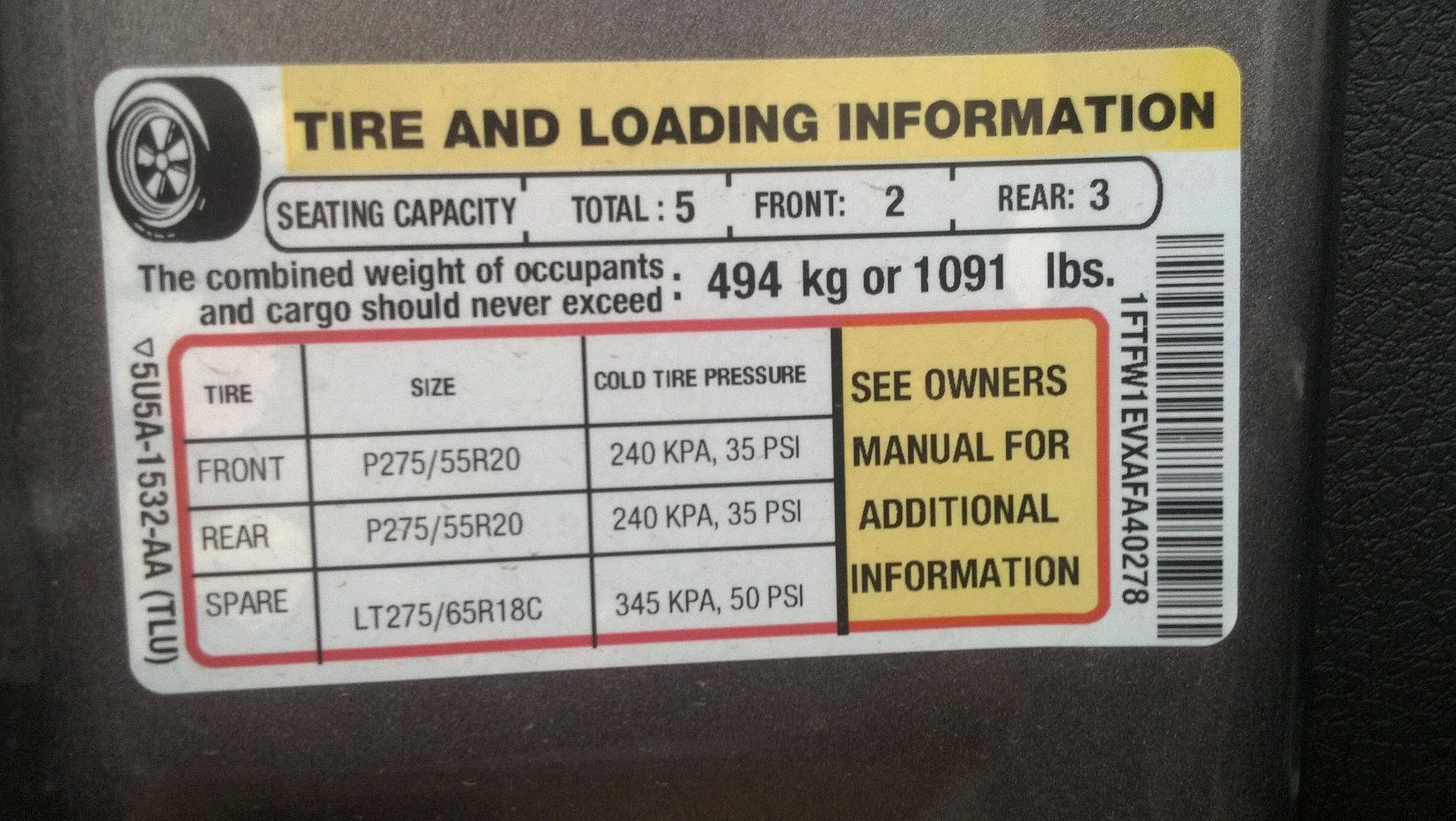
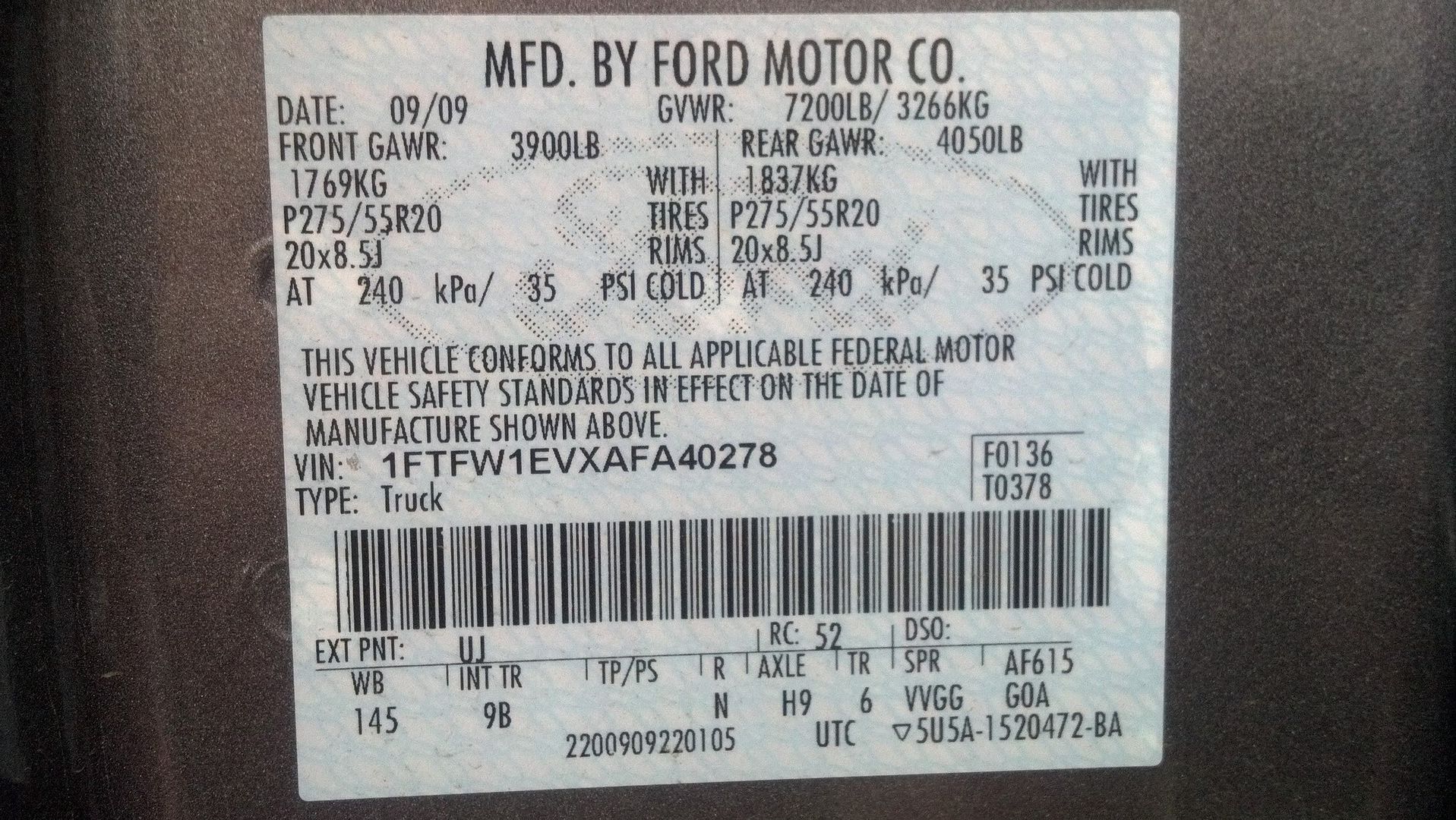
more typically what I'm now concerned with is my situation. My trailer has about a 600lb tongue. I usually have around 600lb of passengers including driver? How is the rating so low?
I should also say I have never felt like I've been bottoming out, or over any limit. I'm just more trying to get a grasp on these numbers.
Below are the pics from my truck for reference. it's a 2010 plat 4x4 screw
I appreciate the help.
5 Year Member
Joined: Feb 2011
Posts: 2,582
Likes: 486
From: Maine
Grumpy Old Man
Joined: Nov 2011
Posts: 3,129
Likes: 886
From: Midland County Texas, just west of the star in my avatar
You can't tow a fifth wheel that weighs 9,600 pounds because the 18 percent hitch weight is more than your truck can handle.
You can't tow a travel trailer that weighs 9,600 pounds because the 12 percent hitch weight is more than your truck can handle. (It's a myth that properly-loaded TTs have only 10 percent hitch weight).
So what does that leave? Wagon-style trailers with only a few pounds hitch weight. Yes, they make them. In cotton country they're called cotton trailers. In grain country they're called grain trailers. The only hitch weight is the weight of the hitch hardware. All the cargo weight in the trailer is supported by the trailer axles. Here's one:

So the truck manufacturers hide behind the fine print that says "never exceed either the GCWR or the GVWR of your tow vehicle". They don't emphasize that the tow rating assumes nothing in the truck but a skinny driver, or that you should compute your max hitch weight before you rely on the "tow rating". Or that the only way to tow that much weight without being overloaded is with a wagon-style trailer.
Senior Member
Joined: Aug 2011
Posts: 1,267
Likes: 24
Segen, yes, that is the disadvantage of the higher trim levels, you don't have much payload left. They are more like a car with a bed. In fact, my wife's station wagon has a higher payload than your F-150, and so did my Toyota Tacoma 4x4 double cab.
The bottom line is if when you add 2,100 lbs like you originally said, you are 100% over your limit. You won't be towing much with your truck if you want to stay within the ratings, especially with 4 people and gear.
At least though, Ford does offer options, like max tow and HD payload.

Senior Member
Joined: Jul 2011
Posts: 1,771
Likes: 204
From: Ontario, Canada
Drive on once with the WDH hitch all set up, and all your gear and the wife and kids, whatever. I position the truck so the middle of the truck is over steer/drive scale boundary, but was told that this really isn't necessary. Just make sure each axle is on a different scale.
Have a long stick to reach the button and call in (you want to be in/on the truck when the weight is taken).
When the operator says the weight is taken, ask for a ticket number for a re-weigh if they don't give it to you.
At most sites, especially when you've got trucks lined up behind you, they'd rather you didn't get out of the cab and fiddle with your hitch. So just drive off.
I then repeat with the WDH spring bars completely slacked.
Finally drop the trailer and do it all again with the Truck only.
Did this a few weeks ago, and it cost $12.50 total.
Calculate the GVW of your trailer by subtracting the Truck-Only Total from one of the Truck+Trailer Totals (they should be the same).
Compare all the GAW's with GAWR's and truck and trailer GVW's with GVWR's.
Calculate the Tongue weight of your trailer by subtracting the GAW of the trailer with WDH spring bars slacked from the Trailer's GVW (that you just calculated above).
Comparing the WDH slacked versus GAW's with the normal WDH will show you how weight is moved off the Drive axle and onto the Steer and Trailer axles.
I've done all this several times with two different trucks and have always found it helpful. Just the last time, it showed the WDH was putting too much
weight onto the Trailer's axle, so I slacked it off a notch.