


Help with a Leveling kit

Senior Member


Joined: Aug 2018
Posts: 8,731
Likes: 4,800

I thought what you are here when I did a 2" level but it wasn't long till I put taller blocks in the back because it would look squat pretty easily (just on an incline, or with a minor load in the bed, some rolls of sod looking squat was what made my mind up real quick)

Senior Member
Joined: Aug 2018
Posts: 8,731
Likes: 4,800



Joined: Jun 2014
Posts: 31,750
Likes: 12,570
From: Nowhereville, Barton City Michigan
2nd on the Bilsteins looking crappy on the winter, they're steel bodied, and even after cleaning them up and a heavy HEAVY spray of clear, 2nd year they looked just as bad. They are a good less expensive shock though, and make a noticeable difference.
I don't think you can wrong with Fox, myself, I'm totally soured on Roush for 150's, so I'd go with the Ford Performance stuff, front and rear.
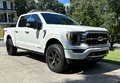
Now, this is what I've got. I used the RanchoQuickLift Loaded on the front, and Fox 2.0's on the rear, along with a Daystar "steel" 2" block. I got a full 2.5" lift with the coilovers, and they are adjustable as far as damping. I've got zero complaints. The Fox do ride a bit stiffer than OEM, but hit some rough roads at a reasonable speed, and it smoothes out.
The Ranchos can be had at a more reasonable cost than Fox, and, since it appears you use your truck the same as me, they'd be fine. If I did more offroading than what I do, fire trails, log roads, all at a speed that I'm not gonna break something or screw up the truck, you'd be fine.
Don't go with spacers, I have and many others have too, with no trouble, you'll do slightly more work installing. The coilovers basically just bolt in, look good, plus you'll get some performance boost on the suspension. I always recommend coilovers anymore.
Although I don't condemn guys that use the spacers.
And yes on the Ubolts, you'll need longer ones if you use aftermarket "lift' blocks.
I don't think you can wrong with Fox, myself, I'm totally soured on Roush for 150's, so I'd go with the Ford Performance stuff, front and rear.
Now, this is what I've got. I used the RanchoQuickLift Loaded on the front, and Fox 2.0's on the rear, along with a Daystar "steel" 2" block. I got a full 2.5" lift with the coilovers, and they are adjustable as far as damping. I've got zero complaints. The Fox do ride a bit stiffer than OEM, but hit some rough roads at a reasonable speed, and it smoothes out.
The Ranchos can be had at a more reasonable cost than Fox, and, since it appears you use your truck the same as me, they'd be fine. If I did more offroading than what I do, fire trails, log roads, all at a speed that I'm not gonna break something or screw up the truck, you'd be fine.
Don't go with spacers, I have and many others have too, with no trouble, you'll do slightly more work installing. The coilovers basically just bolt in, look good, plus you'll get some performance boost on the suspension. I always recommend coilovers anymore.
Although I don't condemn guys that use the spacers.
And yes on the Ubolts, you'll need longer ones if you use aftermarket "lift' blocks.

5 Year Member
Joined: Jan 2016
Posts: 233
Likes: 135
From: Georgia
Untrue. The truck will no longer be stock (but of course that changes the moment you hang an air freshener in it).
OEM stands for Original Equipment Manufacturer, so adding the FoMoCo parts would be changing his truck from stock using OEM equipment. I know it's just semantics, but it is important to understand the nuance because it will lead to misinformation and misinterpreting information and making decisions on bad info.
To the OP, you needn't be concerned whether you use OEM or not beyond choosing your personal preference as the Magnuson-Moss Warranty Act makes it illegal for companies to void a warranty or deny coverage under the warranty because an aftermarket or recycled part was used. Certainly the warranty for the specific part(s) you install won't be covered by Ford, and you'll need to rely on the warranty from whichever manufacturer you ultimately choose to warranty those parts, but you don't need to worry that your vehicle warranty will be void by installing Fox, RC, Bilstein, et al.
Last edited by Nuke83; Nov 12, 2020 at 10:03 AM.
Senior Member
Joined: Aug 2018
Posts: 8,731
Likes: 4,800
Untrue. The truck will no longer be stock (but of course that changes the moment you hang an air freshener in it).
OEM stands for Original Equipment Manufacturer, so adding the FoMoCo parts would be changing his truck from stock using OEM equipment. I know it's just semantics, but it is important to understand the nuance.
To the OP, you needn't be concerned whether you use OEM or not beyond choosing your personal preference as the Magnuson-Moss Warranty Act makes it illegal for companies to void a warranty or deny coverage under the warranty because an aftermarket or recycled part was used. Certainly the warranty for the specific part(s) you install won't be covered by Ford, and you'll need to rely on the warranty from whichever manufacturer you ultimately choose to warranty those parts, but you don't need to worry that your vehicle warranty will be void by installing Fox, RC, Bilstein, et al.
OEM stands for Original Equipment Manufacturer, so adding the FoMoCo parts would be changing his truck from stock using OEM equipment. I know it's just semantics, but it is important to understand the nuance.
To the OP, you needn't be concerned whether you use OEM or not beyond choosing your personal preference as the Magnuson-Moss Warranty Act makes it illegal for companies to void a warranty or deny coverage under the warranty because an aftermarket or recycled part was used. Certainly the warranty for the specific part(s) you install won't be covered by Ford, and you'll need to rely on the warranty from whichever manufacturer you ultimately choose to warranty those parts, but you don't need to worry that your vehicle warranty will be void by installing Fox, RC, Bilstein, et al.
Using an "OEM" part that was not original equipment to your vehicle can cause denial of warranty coverage. For example, if you install suspension components that change the suspension geometry resulting in premature wear of certain joints etc, you might be denied your warranty claim. Just because they are Ford parts doesn't mean you can put whatever you want on your vehicle and maintain 100% warranty coverage of everything
This is precisely why, as you say, if you're going to modify the vehicle, don't worry about whether it's a Ford product or not, there is not necessarily added coverage because it says FoMoCo on the part.
5 Year Member
Joined: Jan 2016
Posts: 233
Likes: 135
From: Georgia
Hopefully we understand the difference between hanging an air freshener and fundamentally altering the mechanics of the vehicle.
Using an "OEM" part that was not original equipment to your vehicle can cause denial of warranty coverage. For example, if you install suspension components that change the suspension geometry resulting in premature wear of certain joints etc, you might be denied your warranty claim. Just because they are Ford parts doesn't mean you can put whatever you want on your vehicle and maintain 100% warranty coverage of everything
This is precisely why, as you say, if you're going to modify the vehicle, don't worry about whether it's a Ford product or not, there is not necessarily added coverage because it says FoMoCo on the part.
Using an "OEM" part that was not original equipment to your vehicle can cause denial of warranty coverage. For example, if you install suspension components that change the suspension geometry resulting in premature wear of certain joints etc, you might be denied your warranty claim. Just because they are Ford parts doesn't mean you can put whatever you want on your vehicle and maintain 100% warranty coverage of everything
This is precisely why, as you say, if you're going to modify the vehicle, don't worry about whether it's a Ford product or not, there is not necessarily added coverage because it says FoMoCo on the part.
My point to the OP was that there is no requirement to use OEM components to ensure warranty coverage. And my comparison of an air freshener was to simply highlight the difference between "stock" and "OEM" is because I see those two used synonymously (which is incorrect) often. I meant no disrespect to you, simply used your post to highlight the difference. Other than the definition, we are in complete agreement.
Senior Member
Joined: Aug 2018
Posts: 8,731
Likes: 4,800
I completely understand, however it is illegal to deny coverage based on the simple point that it is aftermarket equipment. The manufacturer has to prove that anything being denied coverage has been caused by the aftermarket equipment. A couple of examples of what you point out, the failure of a ball joint can't be denied warranty coverage simply because a Monroe strut was installed anymore that the failure in an engine component can't be denied because the owner used Valvoline oil rather than Motorcraft. Now if the incorrect model of shock is used, or an oil that didn't meet required specifications were used, then there is absolute grounds to deny a warranty claim. As a Jeep owner, I frequently see 4" lifts installed without any consideration for geometry, then owners scratch their heads when they get seal and bearing failures throughout the drivetrain. Manufacturer parts installed incorrectly will void warranty claim every time.
My point to the OP was that there is no requirement to use OEM components to ensure warranty coverage. And my comparison of an air freshener was to simply highlight the difference between "stock" and "OEM" is because I see those two used synonymously (which is incorrect) often. I meant no disrespect to you, simply used your post to highlight the difference. Other than the definition, we are in complete agreement.
My point to the OP was that there is no requirement to use OEM components to ensure warranty coverage. And my comparison of an air freshener was to simply highlight the difference between "stock" and "OEM" is because I see those two used synonymously (which is incorrect) often. I meant no disrespect to you, simply used your post to highlight the difference. Other than the definition, we are in complete agreement.

Senior Member

Joined: Feb 2012
Posts: 625
Likes: 32
From: St. Louis area
I don't see any mention of Rough Country. On my previous 2014, I used their coil over set up and loved it. I too am a new owner of 2020 XLT and looking for options. I was leaning towards another Rough Country set up (fronts only) so that I can upsize my tires. Not sure of the price difference.
5 Year Member
Joined: Jan 2016
Posts: 233
Likes: 135
From: Georgia
I still do not agree with the concept that you can modify your vehicle with substantially different (speaking functionally) parts and claim the vehicle is OEM...as the vehicle is no longer as originally equipped from the manufacturer. Maybe people generally see it differently than I do, but I don't consider a truck that's been leveled to be an OEM truck no matter who made the parts used to level it.
So to be clear, the vehicle is "stock" (or Originally Equipped) as delivered from Ford to the Dealer. In many cases, dealers begin adding on components. Window tint, spray in bedliner, aftermarket wheels, lift/leveling kit, etc., none of which would be covered under Ford warranty, but each may carry their own separate warranty from the installer or OEM.
So to specify the vehicle itself as either being OEM or not OEM is really not an accurate use of the term, when "as originally equipped" (or stock) is what you really imply. If you want to leave off the "M", then your definition would apply, the vehicle as "Originally Equipped".
Anyway, slow work day and I'm bored, so at least it's fun having a debate that's not political . . . .
Last edited by Nuke83; Nov 12, 2020 at 04:13 PM.