When you click on links to various merchants on this site and make a purchase, this can result in this site earning a commission. Affiliate programs and affiliations include, but are not limited to, the eBay Partner Network.
First Post Looking for some feedback on TV - TT setup
Hi everyone. Recent purchaser of a 2017 F-150 XLT SCREW 4X4 short box, 5.0, 3.55 w/locking diff., tow package, 36 gal tank and 1880 lb payload. Only 3,000 miles on the truck so its basically new. I've towed a couple of different popups over the last 20+ years but wanted to upgrade the RV along with the more capable truck, so we bought a 2019 Aspen Trail 2390RKS TT and an Equalizer 4 pt WDH.
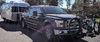
I've been following the Towing Forum throughout the process and have tried to follow the advice of the folks on here with regards to TV payload, TT weight and length, WDH setup etc. Listed dry weight and tongue weight of the TT is 5600/776 lbs with a GVW of 7600 so I knew I was potentially up against the the truck's payload if I wasn't careful. I went through the install and setup process for the Equalizer hitch (measuring fender well heights) and it went better than I expected. The recommended 5 washers and tongue bracket setup returned my front end to within 1/16" of the unloaded height. I did have to raise the shank height one hole from the starting position to get level. Below is a pic of the setup after leveling. (Trailer had a full water tank and most of the gear I will carry in the front pass through storage) It looks a little tongue low but actually was slightly tongue high according to the level on the frame.
I loaded up a bunch of stuff in the truck and trailer and hit the CAT scale today. I'll post the spreadsheet from that separately. Still fumbling around with posting images...
...And here is a screenshot of my CAT scale weights. Trailer fresh water tank and truck's gas tank were full and truck and trailer were loaded with what we will be taking EXCEPT for 200 lbs of spouse and dog who will be in the truck, plus clothes, food and drinks that can ride in the trailer behind the axles (trailer has a rear door and kitchen).
What I think I'm seeing is that I have some capacity to work with in the trailer but after the wife and the pooch that's about all I should haul in the truck. As I said above, food and drink will be in the rear of the TT behind or on top of the axles so tongue weight should not be increased with a full load (which will probably be less fresh water as well)
So am I good to go with this setup? Anything I need to change?
I'll chime in as I've got some related experience. First off, 32 gallons of water weighs 267 pounds. I usually only took enough water to flush the toilet and wash my hands (5 gallons at most) and hooked up (or filled up) once at the campground.
I owned and used an "Equal-I-Zer" brand hitch. Their strong suit is convenience, with sway control built into the W/D aspect. My rig with that hitch was an F-250 SCAB with 10,000 pound camper. Setup completed meticulously by me and perfect. But I never got the sway control I wanted. Tractor trailers passing me would be a two handed white knuckle situation, as were gusting cross winds. No adjustments of toungue weight or W/D helped. In my opinion, that hitch is a compromise at best with sway control suffering.
My last rig was a 2016 Ram 2500 Crew cab with 8 foot bed. Trailer was right at 5,000 pounds. I towed with and without WD and sway control and found no difference. The consensus seems to be if the trailer is less than half the weight of the truck, you can probably tow without sway and W/D. Towed that rig over 8,000 miles with no issues. A big heavy truck and a lightweight trailer...Don't even know it's back there.
If you have trouble with sway, try a Reese Twin Cam hitch. They seem to be the most popular with long distance full timers. It practically locks the truck and trailer together. I think I'm done with large campers but if I towed large campers with my new F-150 that's what I'd invest in. That's a lightweight truck towing a large heavy trailer with LOTS of sail area. Good luck.
Last edited by RickC137; Aug 30, 2018 at 09:42 AM.
If it drives well then it appears to me that you’ve done good. One word of caution about traveling with water, either fill the tank up all the way or leave it empty. The last thing you need is weight moving around behind you in the trailer.
If it drives well then it appears to me that you’ve done good. One word of caution about traveling with water, either fill the tank up all the way or leave it empty. The last thing you need is weight moving around behind you in the trailer.
Last year, when we bought our new TT, I was so cautious about weight I never tried to travel with full fresh water....always empty. This year...totally different! Full fresh water tank for me! It made my rig ride and handle so much better on our 2600 mile holiday trip. Part of it, in my opinion, was that it made the WDH work better.
Last year, when we bought our new TT, I was so cautious about weight I never tried to travel with full fresh water....always empty. This year...totally different! Full fresh water tank for me! It made my rig ride and handle so much better on our 2600 mile holiday trip. Part of it, in my opinion, was that it made the WDH work better.
Same here. Where the tank is located in mine makes TW differences minimal, less than 30 pounds with or without water since the tank is just above the front axle.
I personally noticed a bit better stability when towing with full tank of water myself, however it is located over the dual axel on the TT as opposed closer to the front as others. As 8100hd mentioned, best to either fill it all up or don't fill at all.
Thanks for all the advice. My FW tank appears to be over the rear axle. (I think, it's sealed but the fill and drain are there). I will fill it for the first trip in a couple of weeks. It seemed plenty stable when mostly filled during the 12 mile trip to the CAT scale.


 First Post Looking for some feedback on TV - TT setup