When you click on links to various merchants on this site and make a purchase, this can result in this site earning a commission. Affiliate programs and affiliations include, but are not limited to, the eBay Partner Network.
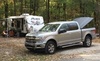
Hey guys before you roll your eyes of another setup with truck and trailer with cat scale numbers I got lost in opinions that I am totally lost.
my thought is to move a small amount on my weight distribution setup so a shade more weight is on the front axle.
2015 f150 3.5 eco boost with tow package.
truck at the moment is pretty level by look and tape.
As you can see before and after with teuck alone and truck with trailer and weight distribution.
Hey guys before you roll your eyes of another setup with truck and trailer with cat scale numbers I got lost in opinions that I am totally lost.
my thought is to move a small amount on my weight distribution setup so a shade more weight is on the front axle.
2015 f150 3.5 eco boost with tow package.
truck at the moment is pretty level by look and tape.
As you can see before and after with teuck alone and truck with trailer and weight distribution.
We need the FAWR, RAWR, GVWR & GCVWR to give informed opinions. Also, the GVWR of the trailer.
I always thought the ideal was front axle stayed pretty close to the same in weight. You are not far off, maybe take it for a test run. Are you loaded as you would be when traveling (both truck and trailer)? Sometimes dialing it in perfect takes a few trips, play with heights, then bam, along comes a windy day. Good luck !
I think your setup will definitely drive better if you can get more weight on your front axle. It is possible to put too much weight back, your steering will feel over-reactive or kind of twitchy, if that makes sense. What has worked best for me is trying a new setup, driving for a bit, then heading to the scale at some point regardless of whether I liked it or not to get an idea of what might be going on. If everything feels great, you're close, but if your steering is light and the scale says your rear axle is heavy, then everything is tracking together (distribute more weight, not less). Mine seems to drive best with about 100lbs less than unladen returned to the front axle, which for me is about 50/50 front rear, but my trailer is about 1000lbs lighter than yours so your ratio will be different, and you may want to return a little bit more to the front. Measuring your fender heights when stock and when loaded, then with weight distribution is a really good shortcut in lieu of a scale. Good luck!
Hey guys before you roll your eyes of another setup with truck and trailer with cat scale numbers I got lost in opinions that I am totally lost.
my thought is to move a small amount on my weight distribution setup so a shade more weight is on the front axle.
2015 f150 3.5 eco boost with tow package.
truck at the moment is pretty level by look and tape.
The ideal method is to also weigh the truck and trailer, hitched, but with the WDH engaged. With all three weights you can use a tool such as TowingPlanner.com to assess how the weight is distributed and whether you're under your limits.
Whatever the case, your tow vehicle is overloaded. No amount of weight distribution will fix that. The combined drive and steer axles, with WDH engaged, is 7340. Your GVWR is 7040. At 6580# with no trailer, you have only 470 available payload capacity for the trailer tongue.
If you're considering shifting some weight from the truck to the trailer, you don't have a lot of room in the trailer. Using the trailer axle weight of 5720 and guessing 12.5% of the trailer weight is on the tongue, that's a total weight of 6537 (5720/0.875). Based on the trailer GVWR of 6884, that leaves you with 346# you can move from truck to trailer without overloading the trailer. Your truck is ~300# overweight. That means it's theoretically possible to move enough from the trailer to get under the truck GVWR. Whether you're successful will be influenced by the % tongue weight your trailer needs to be stable when towing.
In my previous truck, a '16 F150 5.5' SuperCrew, I was at but within all limits. I felt it was safe but it was work to drive it. I have since upgraded to a '21 F150 6.5' SuperCrew with HDPP. The GVWR is 7800# with a payload of 2400. Having more capacity and a longer bed makes driving more comfortable, but that doesn't mean you need to ditch your truck.
If you do redistribute enough to balance things out, you can be within limits, but very close. I don't subscribe to the theory that you shouldn't use more than 80% GVWR. I assume the truck manufacturer's engineers did their calculations so that anything within their ratings was safe. (You have to drive accordingly but the truck is engineered to handle it.) However, I would not assume I was successful without getting 3 weights (one with trailer hitched but WDH disengaged) and plugging those results into a tool like towingplanner.com. That will tell you if you're successful.
I recommend that you consider what you can ditch to reduce weight. Do you need everything in the bed of the truck? Are you bringing every tool you own? Be aggressive in eliminating the things you're unlikely to use regularly, unless it's required for emergencies and not available at Walmart.
It is not unusual that GVWR is the limiting factor in 1/2 ton trucks. You can tow a 16000# trailer but that's if it's attached by a rope, with little weight on the truck. Boats and 4-wheel hay wagons might work; as for trailers with 10-15% tongue weight, you cannot exceed 4700# GVWR without exceeding your truck's GVWR, and that's with only 10% tongue weight. Some trailers require a higher proportion of GVWR to be borne by the tongue to tow well. (My trailer is one of them. It's more stable at 13-15% than at 10-12%. In fact, I don't feel safe at the lower range.)
Last edited by spammagnet; Jun 10, 2024 at 05:27 PM.
. I don't subscribe to the theory that you shouldn't use more than 80% GVWR. I assume the truck manufacturer's engineers did their calculations so that anything within their ratings was safe. (You have to drive accordingly but the truck is engineered to handle it.) .)
It's so refreshing to read a post that believes Auto engineers just might know more than the want-a-be experts that seem to gather online and post their drivel.


 Towing numbers