Help with sway

Thread Starter
Senior Member
Joined: Aug 2012
Posts: 471
Likes: 99
 Help with sway
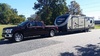
2019 Screw,3.5, 5.5 ft bed, max tow pkg, Goodyear Wranglers, 5500 lb 23 foot TT. Reese Pro (Chinese) Hitch And friction sway bar.
At times, the rear end felt like it was on ice.
I have towed this same trailer with a 2007 F150 and a 2500 Ram. Same hitch set up. Both were stable with the normal amount of push only when a tractor trailer passed.
With the new truck, the rear ended never felt stable.
I have it properly set up using the measurement method and it is adjusted the same as before with previous trucks.
Once I noticed the sway, I cranked down on the sway bar and that took some of it out.
The only other thing I know to try is inflating the Wranglers to max pressure. I ran at 44 psi. They will take 51.
Outside of that, I'm not sure what to try.
Any advice would be much appreciated. Thanks.
And yes, I have searched the forum for answers with no luck.
At times, the rear end felt like it was on ice.
I have towed this same trailer with a 2007 F150 and a 2500 Ram. Same hitch set up. Both were stable with the normal amount of push only when a tractor trailer passed.
With the new truck, the rear ended never felt stable.
I have it properly set up using the measurement method and it is adjusted the same as before with previous trucks.
Once I noticed the sway, I cranked down on the sway bar and that took some of it out.
The only other thing I know to try is inflating the Wranglers to max pressure. I ran at 44 psi. They will take 51.
Outside of that, I'm not sure what to try.
Any advice would be much appreciated. Thanks.
And yes, I have searched the forum for answers with no luck.
Last edited by NC F150; Aug 16, 2019 at 07:54 AM.




Trailer sway is caused by improper weight balance which usually is caused by not enough tongue weight. If loosening up your bars helped than that is proof right there that you need more weight in the tongue and you can prove that out further by loading the trailer front heavy and taking it for a drive to see how it handles. After that have the truck and trailer weighed to find out exactly what your weights are on each axle and the tongue so you know where you need to be.
Thread Starter
Senior Member
Joined: Aug 2012
Posts: 471
Likes: 99
Originally Posted by 2018LLB4x2
It's probably worth confirming loaded weights on a scale to make sure they're still at anticipated ranges. Is the hitch height the same or is that different between vehicles?
I can try taking a link out of the chains and see what that does.

Grumpy Old Man
Joined: Nov 2011
Posts: 3,129
Likes: 887
From: Midland County Texas, just west of the star in my avatar
https://www.etrailer.com/Weight-Dist...e/RP66087.html
Note the hitch at that link includes the shank. But the same hitch is also available without the shank for about $200 less money. I don't know if the shank from your Pro Series hitch will work with the Strait-Line, but if it will, order the one without the shank an save that $200.
But I suspect that 5,500 pounds trailer weight you posted is the dry weight of the trailer, not the GVWR of the trailer. If the GVWR (or dry weight plus CCC) of your trailer is more than 6,000 pounds, then the 800-pound spring bars won't be enough, so you need the spring bars rated for 1,200 pounds.
If you're not stuck in the Reese brand, then Equal-I-Zer and Blue Ox are also good hitches for about the same price as the Reese Strait-Line. And those two brands are available with spring bars rated for 1,000 pounds
Then:, with a good WD hitch:
1] You must know the gross weight and tongue weight (TW) of your wet and loaded trailer. Load the trailer to result in 12% to 14% TW, with 13% as your goal.
2] The trailer should be level, front to rear, after it's all hooked up and the spring bars adjusted. You may need to adjust the ball mount on the adjustable WD shank to achieve a level wet and loaded trailer. If your hitch cannot be adjusted to result in a perfectly level trailer, then a slightly low tongue is better than a slightly high tongue.
3] Adjust the spring bars to result in not more than about a half-inch (and not less than zero) rise in the front end of the tow vehicle compared to the tow vehicle without the trailer tied on. (When you drop the TW on the ball, the front of the tow vehicle will rise an inch or more. You want to tighten the spring bars enough to eliminate most of that rise).
Note: That goal of a half-inch rise is an "about" number. Depending on the tow vehicle and trailer, you may be able to fine tune the rise to result in better towing comfort..
That hitch should be fine short of maybe needing a different set of bars. Ive been towing my Travel trailers for ten years with a "cheap" Pro series hitch with now sway control and have never had a sway problem UNLESS the trailer was improperly loaded or the hitch was not set up properly. You dont need a $1000 hitch to tow a 6000 pound travel trailer.



Trending Topics
Thread Starter
Senior Member
Joined: Aug 2012
Posts: 471
Likes: 99
Thanks all.
The trailer is level as set up.
So as I understand it. I can tighten or loosen the 1000 lb bars from where I am now. One or the other settings should work? If one of those settings works, there's really no advantage to weighing.
5500 is the wet trailer weight. 950 is tongue weight with WD hitch.
The trailer is level as set up.
So as I understand it. I can tighten or loosen the 1000 lb bars from where I am now. One or the other settings should work? If one of those settings works, there's really no advantage to weighing.
5500 is the wet trailer weight. 950 is tongue weight with WD hitch.
Last edited by NC F150; Aug 16, 2019 at 02:59 PM.