When you click on links to various merchants on this site and make a purchase, this can result in this site earning a commission. Affiliate programs and affiliations include, but are not limited to, the eBay Partner Network.
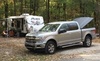
Hey y’all, first time truck owner here. I recently bought both the truck and camper and wanted to make sure I have all my ducks in order before doing a long trip.
You seem to have it all lined up so you'll be fine .. since you said it is your first truck, just going to assume you may not have a lot of towing experience. So just keep this in mind - your towing a giant wind sail behind you. Your MPG is going to drop - a lot - and the more over 55mph you tow the more it is going to drop. So don't be alarmed or shocked, it's not a power/payload thing, its wind resistance across the front of your trailer. Very nice looking truck!
IMO, especially because you are really close on the numbers, it is more important to really get the trailer and wdh dialed in. Just from observing, seems your trailer is not level and is nose high, you would rather it be a tad nose low than nose high after it is loaded, it will impact towing dynamics. Your truck stance looks good just from observing.
You seem to have it all lined up so you'll be fine .. since you said it is your first truck, just going to assume you may not have a lot of towing experience. So just keep this in mind - your towing a giant wind sail behind you. Your MPG is going to drop - a lot - and the more over 55mph you tow the more it is going to drop. So don't be alarmed or shocked, it's not a power/payload thing, its wind resistance across the front of your trailer. Very nice looking truck!
Thank you! Yes, I was definitely surprised…when I saw 8mpg I couldn’t believe it. I hovered around 55-60mph taking it to a storage.
Hey y’all, first time truck owner here. I recently bought both the truck and camper and wanted to make sure I have all my ducks in order before doing a long trip.
Is there anything else I should be considering when towing? I have the max trailer tow package as well.
How did you come up with the tongue weight, i.e. what are you basing that 13% on?
Since you are using a percentage, that would seem to indicate that you did not do the CAT scale 3 pass method to calculate tongue weight. If this is true, ensure you are basing your 13% on the trailer GVWR, not the dry weight posted on the trailer or a brochure listed tongue weight.
IMO, especially because you are really close on the numbers, it is more important to really get the trailer and wdh dialed in. Just from observing, seems your trailer is not level and is nose high, you would rather it be a tad nose low than nose high after it is loaded, it will impact towing dynamics. Your truck stance looks good just from observing.
Thanks for your reply! There’s a setting on the F150 cluster that shows the degrees of the truck and if it’s aligned. I saw 0 degrees for both horizontal and vertical alignment so I somehow set up the distribution hitch correctly the first time. It’s a good reminder tho, thanks!
How did you come up with the tongue weight, i.e. what are you basing that 13% on?
Since you are using a percentage, that would seem to indicate that you did not do the CAT scale 3 pass method to calculate tongue weight. If this is true, ensure you are basing your 13% on the trailer GVWR, not the dry weight posted on the trailer or a brochure listed tongue weight.
Oh, let me look up the CAT scale 3 method. These are the specs on the manual for the camper so I just divided by dry weight.Dimensions: 25.58’ x 8’ x 10.25’
Oh, let me look up the CAT scale 3 method. These are the specs on the manual for the camper so I just divided by dry weight.Dimensions: 25.58’ x 8’ x 10.25’
If you don’t know the true weight of the loaded-for-camping trailer, general rule of thumb is take 13% of trailer GVWR as tongue weight. Your trailer GVWR is 5,826 (4,515 + 1,311). That equals 757 lbs of tongue weight at 13%..
it’s all a guesstimate until you actually weigh it, but using GVWR and not dry weight gives you a safety margin and allows for a worst case scenario.
It is a good idea to put basic info about your truck in the the post so people can give better advice. Specifically the engine and axle ratio matter too.
You're within 100 lbs of your max payload with an empty trailer. If I'm reading this right the empty trailer is 4515. If fully loaded with 1311 lbs of gear it will weigh 5826. If so, your loaded tongue weight will be 757 lbs. That will put you over payload by a little. You probably won't actually have 1300 lbs of gear in the trailer, but will have more than the 150 lbs you've listed. Your truck can handle this trailer, but you're close, maybe over by a small amount. I'd pull it, but you might have to pack carefully.
330 lbs for passengers is pretty light too. You don't say, but lots of families have small kids and don't consider that they grow. My son went from 5'3 and 140 lbs to 6'3 and 240 lbs between 8th and 10th grade. Four adults in a truck can easily be 600-800 lbs and 4 big men could exceed 1000.
You mention long trips. Altitude matters. Tow ratings are calculated on level ground and at sea level. Start pulling up mountains and at altitude and the amount you can tow should be reduced. About 2-3% for every 1000' above sea level. There are lots of mountain passes in the Rockies where you'll be at 9000-11,000'. Many places on level ground at 5000-7000'. That means 10%-30% less towing capability than the charts say. This is where knowing the engine and axle ratio help. The 3.5 EB engine handles altitude better than the 5.0 V8.
If you don’t know the true weight of the loaded-for-camping trailer, general rule of thumb is take 13% of trailer GVWR as tongue weight. Your trailer GVWR is 5,826 (4,515 + 1,311). That equals 757 lbs of tongue weight at 13%..
it’s all a guesstimate until you actually weigh it, but using GVWR and not dry weight gives you a safety margin and allows for a worst case scenario.


 Fist time towing