


Oil Usage / Consumption


Thread Starter
Member

Joined: Sep 2017
Posts: 77
Likes: 6
From: Florida
 Oil Usage / Consumption
I read in the OM the guidance on adding oil. So, I'll assume that they figure that the owner may need to add / top off oil in between changes or they would have no
need to give instructions on how to add (no entire oil change) oil.
So, I've found myself needing to top off (about .5 to .75 qt) about every 6 to 8 weeks / 2k miles even though the OM says that there is no danger as long as the level is anywhere between bottom line and top line.
I do pull a TT occasionally if that is useful info. I was under the assumption (yes I know) that baring unusual circumstances, the vast majority of engines manufactured these days should not need oil added in between routine / scheduled changes. So does my need to add oil in between changes seem out-of-the-norm or well within expectations?
If anyone can shed light on this situation, I'd appreciate it. Thanks in advance.
need to give instructions on how to add (no entire oil change) oil.
So, I've found myself needing to top off (about .5 to .75 qt) about every 6 to 8 weeks / 2k miles even though the OM says that there is no danger as long as the level is anywhere between bottom line and top line.
I do pull a TT occasionally if that is useful info. I was under the assumption (yes I know) that baring unusual circumstances, the vast majority of engines manufactured these days should not need oil added in between routine / scheduled changes. So does my need to add oil in between changes seem out-of-the-norm or well within expectations?
If anyone can shed light on this situation, I'd appreciate it. Thanks in advance.


Senior Member
Joined: Jun 2017
Posts: 2,336
Likes: 451
From: Memphis TN
I have to do this.
It is considered within the normal oil consumption use to need 2-3 quarts per month or 3000 miles of driving. says basically every dealer shop for almost any make sold in the US.
Now realistically you shouldn't have to add much if any between oil changes - but your engine does use some oil. I don't care who you are - your ford truck uses some oil between oil changes. The oil everyone uses is taken away via PCV. Either the Ecoboost or the 5.0 removes some oil via the PCV process - and that amount varies a good bit based on engine temps, how hard it's driven, and etc.
People that have a catch can system - see this every time they empty them. Everyone else - it burning it though the engine and lightly coating the intake manifold, runners, and valves. And the engine is designed for this so it's a known thing. The range between the hash marks on the dip stick is 1.5 quarts if I recall correctly or something around that - it varies by engine. And is representative of the PCV loss over the course of the OLM design period. Note that LOW on the dipstick doesn't set off a low oil quantity condition on the computer - that is closer to 2 quarts remaining - again if I recall correctly.
Top Hash mark - full 6 quarts - bottom hash mark something like 4.5 quarts - bottom of the stick - 2 quarts and low oil quantity light and protections (engine won't start below that)
Hope that helps a bit. I would say if you are towing which means you are in lower gears and longer time at higher RPM's needing a little on occasion to stay in the hash marks is normal. If you are putting in 2 quarts at a time I'd start to worry about rings or the turbo leaking oil or something. (turbo's can leak oil into the airstream such that it's not dripping on the group and the car isn't necessarily smoking)
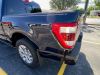
Incidentally I see you have the pedal commander device - that tells me you are driving the engine harder than you think you are - remember it's faking out the computer on input pedal position so you're higher in the throttle opening % than normal - more often. That might have a bit of a factor - the higher the RPM's and load the more PCV venting is occuring.
It is considered within the normal oil consumption use to need 2-3 quarts per month or 3000 miles of driving. says basically every dealer shop for almost any make sold in the US.
Now realistically you shouldn't have to add much if any between oil changes - but your engine does use some oil. I don't care who you are - your ford truck uses some oil between oil changes. The oil everyone uses is taken away via PCV. Either the Ecoboost or the 5.0 removes some oil via the PCV process - and that amount varies a good bit based on engine temps, how hard it's driven, and etc.
People that have a catch can system - see this every time they empty them. Everyone else - it burning it though the engine and lightly coating the intake manifold, runners, and valves. And the engine is designed for this so it's a known thing. The range between the hash marks on the dip stick is 1.5 quarts if I recall correctly or something around that - it varies by engine. And is representative of the PCV loss over the course of the OLM design period. Note that LOW on the dipstick doesn't set off a low oil quantity condition on the computer - that is closer to 2 quarts remaining - again if I recall correctly.
Top Hash mark - full 6 quarts - bottom hash mark something like 4.5 quarts - bottom of the stick - 2 quarts and low oil quantity light and protections (engine won't start below that)
Hope that helps a bit. I would say if you are towing which means you are in lower gears and longer time at higher RPM's needing a little on occasion to stay in the hash marks is normal. If you are putting in 2 quarts at a time I'd start to worry about rings or the turbo leaking oil or something. (turbo's can leak oil into the airstream such that it's not dripping on the group and the car isn't necessarily smoking)
Incidentally I see you have the pedal commander device - that tells me you are driving the engine harder than you think you are - remember it's faking out the computer on input pedal position so you're higher in the throttle opening % than normal - more often. That might have a bit of a factor - the higher the RPM's and load the more PCV venting is occuring.

Senior Member
Joined: Mar 2018
Posts: 328
Likes: 83
How many miles are on your truck? The owners manual states that it takes around 3000 miles of break in for oil consumption to be normal?
I'm also kind of concerned because I checked oil level for the first time and it was 1 qt low at 1k mi. I don't know if factory fill was low or if it was consumed. I'll await the 3000 mile break in point and see what happens. Some guys say that this 5.0 tends to use oil when new but not after break in.
I'm wondering if 5W-20 tends to get consumed faster then 5W-30. Ford switched to 5W-20 for CAFE. Was the tradeoff higher consumption?
I'm also kind of concerned because I checked oil level for the first time and it was 1 qt low at 1k mi. I don't know if factory fill was low or if it was consumed. I'll await the 3000 mile break in point and see what happens. Some guys say that this 5.0 tends to use oil when new but not after break in.
I'm wondering if 5W-20 tends to get consumed faster then 5W-30. Ford switched to 5W-20 for CAFE. Was the tradeoff higher consumption?

5 Year Member


Joined: Nov 2016
Posts: 3,263
Likes: 1,177
When I bought my truck the oil level from the factory fill was exactly in the middle of the cross hatched area, not at the full mark. Keep this in mind, even if you have to add a quart it only burned a 1/2 quart because they are not filled to the max at the factory. After about 1,000 miles (after following the break in procedure) it did go down some so I added a 1/2 quart. About a 1,000 miles later it went down again and I added the other 1/2 quart. By the time I got to the first oil change at 10,000 miles it was a little below the 1/2 way mark on the dipstick but still in the cross hatched area. Since the first quart I added when it was new it really doesn't burn any oil. I would say at most it's about a 1/2 quart at every 9,000 - 10,000 mile oil change. Which in reality could be considered not burning any oil.
Last edited by RL1990; Sep 6, 2018 at 05:41 PM.
Senior Member
Joined: Jun 2017
Posts: 2,336
Likes: 451
From: Memphis TN
How many miles are on it now - when was the last oil change? I know it's a matter of myth but I still like to change the oil in a new vehicle somewhere in the first 1000 to 2000 miles, then do it again around 5000.
From there I do 30% OLM or there about. Again though - what you describe does sound mostly within the range of PCV venting use.
And yes is it absolutely possible that with miles (2-6000 or so) that the rings, valve seals, etc to run in and set correctly.
To your other question - on the 5-20. One it was done to help with fuel economy, it is thinner than 5-30 and as such it doesn't have the shear properties and other effects it does however cling to the metal as well. I know that seems odd but it does. Being thinner and a bit lighter in density it can and will contribute to extra PCV venting however if I recall correctly the engine was modified for this as well. Note as the move to 20 and lighter weight oils began, engines started to use different sized or different composition bearings and surfaces. So wear is not so much an issue. Also the oil pumps have gotten higher in volume and lower in pressure - or same pressure so that's another difference.
If you are still adding this much by say 10,000 miles then either it's leaking it into the combustion chamber or you are running it hard enough to have excessive PCV venting. However I will say this if you are towing weekly and that means you run the engine to say 2700 or so RPM, under load, for over an hour - you will have more PCV venting than someone that runs with overdrive enabled and highway speeds at lower gears.
In simple terms the harder you run the engine you are moving more air per minute - move more air per minute some of that air is PCV vent gas so you move more PCV vent gas too. Based on what you said earlier it seems you might fall into this category. One thing I would suggest and seeing when you tow you can do so in higher gears but I don't know where you are so that might not be possible for you either.
From there I do 30% OLM or there about. Again though - what you describe does sound mostly within the range of PCV venting use.
And yes is it absolutely possible that with miles (2-6000 or so) that the rings, valve seals, etc to run in and set correctly.
To your other question - on the 5-20. One it was done to help with fuel economy, it is thinner than 5-30 and as such it doesn't have the shear properties and other effects it does however cling to the metal as well. I know that seems odd but it does. Being thinner and a bit lighter in density it can and will contribute to extra PCV venting however if I recall correctly the engine was modified for this as well. Note as the move to 20 and lighter weight oils began, engines started to use different sized or different composition bearings and surfaces. So wear is not so much an issue. Also the oil pumps have gotten higher in volume and lower in pressure - or same pressure so that's another difference.
If you are still adding this much by say 10,000 miles then either it's leaking it into the combustion chamber or you are running it hard enough to have excessive PCV venting. However I will say this if you are towing weekly and that means you run the engine to say 2700 or so RPM, under load, for over an hour - you will have more PCV venting than someone that runs with overdrive enabled and highway speeds at lower gears.
In simple terms the harder you run the engine you are moving more air per minute - move more air per minute some of that air is PCV vent gas so you move more PCV vent gas too. Based on what you said earlier it seems you might fall into this category. One thing I would suggest and seeing when you tow you can do so in higher gears but I don't know where you are so that might not be possible for you either.