Normal Vacuum readings?


Thread Starter
Junior Member
Joined: Aug 2012
Posts: 6
Likes: 0
 Normal Vacuum readings?
1995 F150, 351W 5.8L
Is there someone that can tell me what the vacuum reading should be off the fuel pressure regulator, and off the intake brake booster?
I've heard it's bad if it goes to 0 when I punch the throttle too...true?
Also on the fuel pressure blead down test...mine will drop from 35 to 20 after 1 min...is that bad?
Thanks!
Is there someone that can tell me what the vacuum reading should be off the fuel pressure regulator, and off the intake brake booster?
I've heard it's bad if it goes to 0 when I punch the throttle too...true?
Also on the fuel pressure blead down test...mine will drop from 35 to 20 after 1 min...is that bad?
Thanks!
Thread Starter
Junior Member
Joined: Aug 2012
Posts: 6
Likes: 0
Hey thanks! I'm at 6500 feet elevation so my 13-15 in.hg reading should be pretty good (read to subtract 1in for every 1000 feet ASL).
I don't know a lot about engines, but should all the vacuum places I measure be about the same range (15-22 in.hg)? Or are some higher/lower than others?
And I read on the fuel bleed down it should stay around 5 psi after 1 min...mine drops to 20 psi after a minute...is that going to be a problem?
I don't know a lot about engines, but should all the vacuum places I measure be about the same range (15-22 in.hg)? Or are some higher/lower than others?
And I read on the fuel bleed down it should stay around 5 psi after 1 min...mine drops to 20 psi after a minute...is that going to be a problem?

Salvage Yard Pro
Joined: Feb 2012
Posts: 2,543
Likes: 129
From: Keithville, La
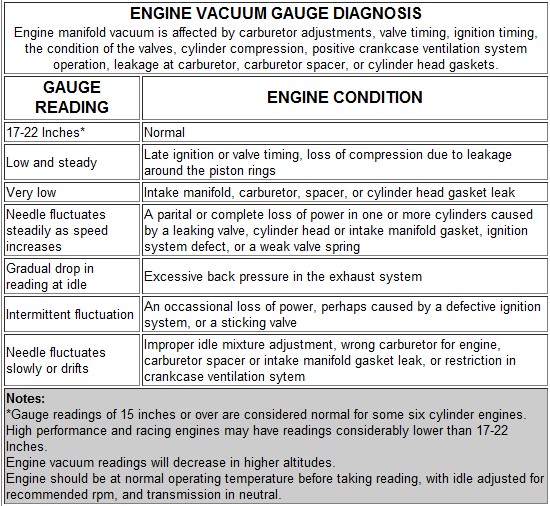
I can't answer the fuel pressure questions, but the vacuum needs to be from a constant vacuum source, Ie a manifold tap or brake booster tap. I used a tee on the brake booster vacuum line. I found that to be the best source. I haven't installed a permanent gauge yet but plan to do so shortly. Vacuum can tell you allot about the health of your engine. Your right on with the drop in vacuum with a gain in altitude. Your 13-15 in.hg should be great if idle vacuum stays steady with no pulsation or gradual drop. Add back 6 in.hg for sea level and your at 21in.hg which is awesome. Here's a quick reference chart for vacuum symptoms.