When you click on links to various merchants on this site and make a purchase, this can result in this site earning a commission. Affiliate programs and affiliations include, but are not limited to, the eBay Partner Network.
Napa is still in the adalecent stages of the retail side compared to say advance and orielly. We still load a disc into the server once a week for one of the catalogs. The other is updated continuously.
BTW, if anyone is looking at buying parts from MMR, checkout their ebay page first to see if they have your parts on there. I found the same chain guides for $10 less than on their website...plus free shipping! So I ended up getting the guides along with the cam phasers for cheaper and all shipped free-which was going to be $54 on their website. Plus credit card points, ebay bucks and ebates back on my purchase. Not too shabby!
I just ordered OEM phasers from Freedom Ford (through their Ebay site) for $229.00 each - PLUS was able to put them on PayPal 6 month pay, no interest!. At that small a differential in price, I would be concerned about possible subtle differences in aftermarket phasers that could effect the VVT systems operation.
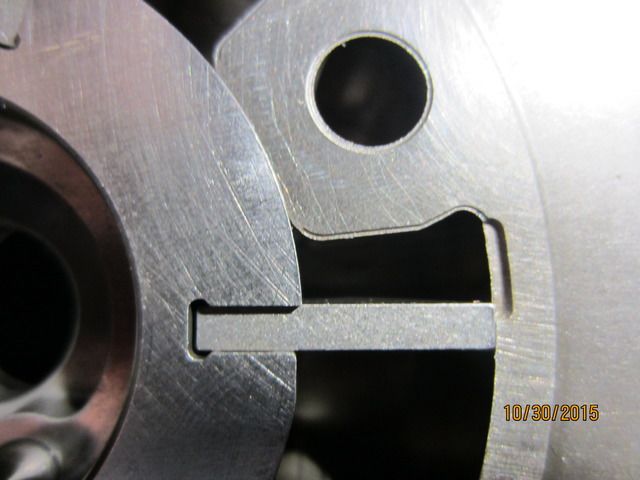
One such possible difference appears in this photo of the inside of a Ford OEM phaser.
If you disassemble an OEM phaser, you find it has two such milling at two (2) of the five chambers. I have seen photos of the inside of the DORMAN, and it has no equivalent milling around any of its chambers. Of course I know nothing about the Echlin and no ideas if they have a corresponding feature. In fact, I'm no expert and most of what I know (or think I know) came from the these forums and the Google box. (basically it can all be comfortably written on the back of a 3 cent postage stamp in longhand) Lol. BUT: I'm an insatiably curious and logical individual.
I've tried to rationalize the design purpose of these subtle millings, and have basically concluded the following (IMHO):
1) This photo was taken with the "locking pin" aligned with its lock position (ie the hole). The result of this small machining must be (by applying hydro flow dynamics) - if the Phaser advances PAST the locking pin, "due to excessive oil pressure from the VCT solenoid" - the machined passage-way provides leakage to equalize hydraulic pressure between advance and retard chambers, allowing the phaser locking pin to capture its locking hole. I believe (with absolutely NO supporting authority) that this is probably ZERO degrees advance. [[ I've posed this question on these forums with hundreds of reads and ZERO responses at: https://www.f150forum.com/f12/5-4l-p...8/#post4160750 ]]
2) Having actually monitored cam phaser OBDII signals, to advance the cams the ECU removes ALL duty cycle pulses from the VCT solenoids. Electrically it would be the same as unplugging them both. This routes ALL (available) oil pressure through the VCT Solenoid to the 'advance' chambers in the phaser - pushing the vanes toward advance. NOTE: I said "available" oil pressure because THIS is a "variable" in the equation.
3) At low rpms (such as at idle) oil pressure is low or near the 25 lbs or so where the locking pin can capture & lock, and it snaps into the locking hole. If rpms is slightly higher or oil pressure is slightly higher - the pressure relief passage-way equalizes pressure between advance / retard chambers around ZERO degrees advance so the pin can "LOCK".
4) If ENGINE POWER or higher rpms is required - obviously rpm increases and oil pressure jumps higher (> 25lbs) and releases the locking pin. With zero duty cycle pulses being applied to the solenoids, all (available) oil pressure would still be being routed into the advance chambers - and thus could over come the flow rate possible through the two (2) small machined pressure relief passage-ways, thus pushing the phaser vane all the way to FULL ADVANCE (perhaps 5 - 8 degrees advance).
IF THIS THEORY (only a theory) is correct - I would wonder if some of the aftermarket phasers would provide all the benefits the Ford designer's intended? Certainly, the "lockouts" force the pasers to FULL ADVANCE - whatever degrees advance that actually is. And I believe the DORMAN phaser go to that position every time duty cycle pulses are removed from the VCT solenoids.
As for the Echlin, I have NO idea. FWIW
Last edited by F150Torqued; Jan 19, 2016 at 11:23 AM.
I just ordered OEM phasers from Freedom Ford (through their Ebay site) for $229.00 each - PLUS was able to put them on PayPal 6 month pay, no interest!. At that small a differential in price, I would be concerned about possible subtle differences in aftermarket phasers that could effect the VVT systems operation.
One such possible difference appears in this photo of the inside of a Ford OEM phaser.
If you disassemble an OEM phaser, you find it has two such milling at two (2) of the five chambers. I have seen photos of the inside of the DORMAN, and it has no equivalent milling around any of its chambers. Of course I know nothing about the Echlin and no ideas if they have a corresponding feature. In fact, I'm no expert and most of what I know (or think I know) came from the these forums and the Google box. (basically it can all be comfortably written on the back of a 3 cent postage stamp in longhand) Lol. BUT: I'm an insatiably curious and logical individual.
I've tried to rationalize the design purpose of these subtle millings, and have basically concluded the following (IMHO):
1) This photo was taken with the "locking pin" aligned with its lock position (ie the hole). The result of this small machining must be (by applying hydro flow dynamics) - if the Phaser advances PAST the locking pin, "due to excessive oil pressure from the VCT solenoid" - the machined passage-way provides leakage to equalize hydraulic pressure between advance and retard chambers, allowing the phaser locking pin to capture its locking hole. I believe (with absolutely NO supporting authority) that this is probably ZERO degrees advance. [[ I've posed this question on these forums with hundreds of reads and ZERO responses at: https://www.f150forum.com/f12/5-4l-p...8/#post4160750 ]]
2) Having actually monitored cam phaser OBDII signals, to advance the cams the ECU removes ALL duty cycle pulses from the VCT solenoids. Electrically it would be the same as unplugging them both. This routes ALL (available) oil pressure through the VCT Solenoid to the 'advance' chambers in the phaser - pushing the vanes toward advance. NOTE: I said "available" oil pressure because THIS is a "variable" in the equation.
3) At low rpms (such as at idle) oil pressure is low or near the 25 lbs or so where the locking pin can capture & lock, and it snaps into the locking hole. If rpms is slightly higher or oil pressure is slightly higher - the pressure relief passage-way equalizes pressure between advance / retard chambers around ZERO degrees advance so the pin can "LOCK".
4) If ENGINE POWER or higher rpms is required - obviously rpm increases and oil pressure jumps higher (> 25lbs) and releases the locking pin. With zero duty cycle pulses being applied to the solenoids, all (available) oil pressure would still be being routed into the advance chambers - and thus could over come the flow rate possible through the two (2) small machined pressure relief passage-ways, thus pushing the phaser vane all the way to FULL ADVANCE (perhaps 5 - 8 degrees advance).
IF THIS THEORY (only a theory) is correct - I would wonder if some of the aftermarket phasers would provide all the benefits the Ford designer's intended? Certainly, the "lockouts" force the pasers to FULL ADVANCE - whatever degrees advance that actually is. And I believe the DORMAN phaser go to that position every time duty cycle pulses are removed from the VCT solenoids.
As for the Echlin, I have NO idea. FWIW
Your knowledge is far superior to mine on this topic but I do far better understand what is happening now and I greatly appreciate the in depth explenation. The reason I am even considering Echlin is because for one they are made standard motor company and are know for quality and two, I work at napa and get a very nice discount, brings it down to around $140 a piece. For an entire timing job it is right under $600. I also can return items for a refund quite easily. I would love to order one of these in and inspect it.