When you click on links to various merchants on this site and make a purchase, this can result in this site earning a commission. Affiliate programs and affiliations include, but are not limited to, the eBay Partner Network.
Let's keep in mind hat MC phasers aren't perfect. I had a brand new one from the dealer with 1 of 3 pins backing out that holds the thing together. Luckily I was able to press it back in, and the phaser bolt head covers it so I don't have to worry about it working loose.
Well obviously there's going to be a screwup here and there. Law of averages. Sooner or later it'll happen. That doesn't mean MC isn't better than Dorman.
Well obviously there's going to be a screwup here and there. Law of averages. Sooner or later it'll happen. That doesn't mean MC isn't better than Dorman.
But what IS confusing about your response, is when you say .... "... I will give up in return for an engine I know will be mechanically more sound." how do the lockouts make the engine more sound?
F150Torqued, I completed my job in August (page 223 this thread). And agree that Lockouts are an expensive trick. To troubleshoot my problem, I did exactly what you've stated previously; unplugged the VCTs. Basically setting the phasers to full advance. I had no stalling for several days. Plugged them back in and you know the rest. Like most, chain guide broken, tensioners in bad shape which is the chain rattle noise. BTW, can you explain how the phaser makes rattling noise? I missed that explanation.
Well replaced it with. started up sounded great. Took it for test run and when floored it ran like crap. Well... Plastic pieces got caught up in the oil pick up. Should have checked that sooner then later. Still need to test it more but it's much better. So I had a lot of people give me there opinion from just defective to inserted wrong. I think it wasn't seated correctly or tourqued incorrectly. But I think it's fixed that what matters.
FIRST, (being hyper politically correct and not argumentative, solely for the sake of accuracy when it comes to the wildly misunderstood 5.4 vvt system). You are correct that steady driving at almost any speed (ie: cruising) causes high (often maximum) degrees of RETARD. I believe however that the 50/50 you mention refers to duty cycle of the VCT Solenoids [OBDII signal CAMDCR, PID #16CF] instead of the phaser vane locations specifically. Around 50% duty cycle on the spool valves places equal oil flow (thus equal pressure) into both RETARD & ADVANCE chambers of the phaser - HOLDING the vanes at their current position, whatever that might be.
Monitoring this PID on my truck under various driving conditions reveals that it (CAMDCR) bobbles around 46-47% (Hot), 40-41% (Cold - [because of thicker oil? I think]). Slight increase in acceleration makes CAMDCR bounce up "momentarily", then settle back to normal %, bobbling around to hold, or modulate the vanes at a desired position. Higher engine load (>60-70% load) begins to reduce CAMDCR toward - and ultimately to - ZERO. Letting completely off the throttle always drops it to ZERO - putting 100% oil flow into advance chambers (full advance on the phaser vanes). I have verified this by monitoring live OBDII data for the ECU's requested retard (RCAM, PID #16CD) signal and cam retard error (CAMERRR, PID #16CE).
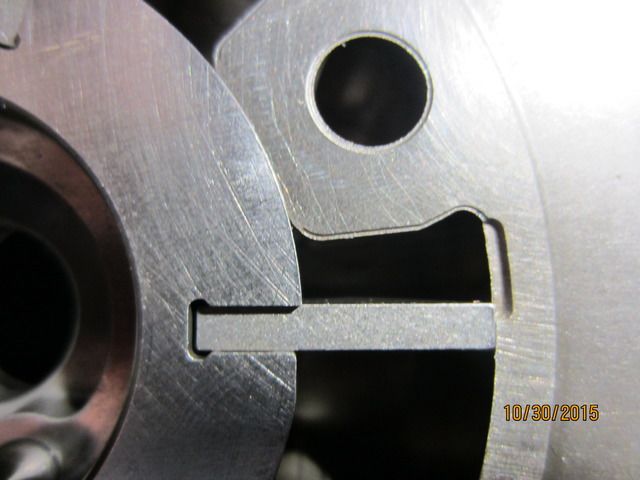
SECOND. Thank you 1,000,000 for the phenomenally sharp close-up photo. A COMPLETE REVALATION TO ME! Never have I noticed that machined passageway in a phaser photo before. (Hope you don't mind - I'm reposting your photo here for discussion)
On closer inspection I now see this machined grove is visible in several other phaser photos in the forums, on what seems to be TWO (2) chambers across from each other. [For full disclosure - I have not personally done a phaser job or taken a phaser apart, YET - but it's coming soon).
But on seeing the above photo my HYPER analytical pea-brain exploded into action. That machining isn't accidental! Oil leakage through that small milled passageway would tend to equalize and cancel out hydraulic pressure differential in the advance/retard chambers before "maximum advance" is achieved. The solenoid valve is at 0% duty cycle when it is calling for full advance. However - Oil pressure at idle (say <= 25 lbs) might be insufficient to push the vanes completely to full advance because of the pressure equalization caused by these little passageways. HOWEVER, OIL PRESSURE "JUMPS" promptly with a few RPMs - and mine reaches 45-50 Lbs by 1000 RPMs. Perhaps at that increased volume of oil flow, with all oil being routed into the advance chamber by the solenoid at Zero % duty cycle - the phaser would be able to push the vane all the way to the chamber end???
Is it possible that that little grove is to provide, - say - ZERO DEGREES ADVANCE at idle - but a FEW DEGREES TRUE ADVANCE above at or
above 800 or so?????? An engine will idle better at 0º than it will with some advance, and power is increased with a few degrees advance at moderate RPM. (I have witnessed a unexplainable phenomenon while monitoring the above mentioned OBDII signals). Sometimes, when RCAM is Zero, and CAMDCR is ZERO, - specifically, under a moderate load at moderate RPMs, CAMERRR will become fairly consistently negative - say 4º - 5º. Could THIS little machined oil passageway be the explanation??? I have witnessed the PCM begin to call for retard - (RCAM & CAMDCR come up) at very high RPMs.
This also brings back to mind a question that I posted on three separate forums for which I have never gotten a answer - in spite of over 1000 total views. https://www.f150forum.com/f12/5-4l-p...dvance-300748/ I still need to perfect my formula to display correct advanceº / retardº on my custom gauges.
Last edited by F150Torqued; Nov 29, 2015 at 03:11 PM.
Reason: cut / past didn't get everything! darned computers
The Final Repair Guide to 5.4 Cam Phaser Tick/Knock Sound
Originally Posted by Phasedout
... BTW, can you explain how the phaser makes rattling noise? I missed that explanation.
You missed that because I didn't try explaining it. Basically, I don't think the phasers make a "rattling noise". Sounds are as difficult to articulate as they are it locate, but the rattling noise, most often occurring in the first couple of seconds of startup, or sometimes at higher rpm idle (1000-1500), and sometimes described as "marbles in a coffee can", almost has to be the timing chain making contact with the timing cover - or the surface of a broken chain guide. THAT can not happen as long as chain guides are not broken and keeping chains in their proper channels, AND if the tensioners are keeping proper tension on chains.
I believe the question originated in part from my asking " ... how do the lockouts make the engine more sound?". Neither of the above failure conditions are, eliminated, lessened, (or aggravated for that matter) by Livernois lockouts.
That clasic low, throaty, knocking (or "diesel") sound at idle however is a different story. By no means can my opinion be classified as "expert" (as I have actually never done a phaser job - YET). But I believe the phasers are responsible for that one, and while I don't consider it, in itself, a "failure" or any more than a colossal annoyance, lockouts WILL eliminate it. I believe its origin is in the phaser internal parts slapping against either (or both) the slack in the locking pin or the chamber ends. THIS OCCURS, I believe, because the camshafts are thrust FORWARD by the rollers on the 'heal' of cam lobes, and create drag on the 'toe' of cam lobes trying to overcome valve spring resistance - every OTHER revolution of the engine. (NOTE: many experience camshafts move when chains are removed while changing phasers because of these forces.)
I'm really not sure I buy the theory that the culprit cause of this is low oil pressure. Note my immediately previous post.
The effect of these irregular forces may be responsible of some of what's described as "chain slap" on startup (especially if tensioners have insufficient pressure or are faulty), but lockouts would not correct, improve, or stave off development of this situation.
I noted with great interest what @Fordjunkync said in his post 2334 on page 234 of this forum @ ( https://www.f150forum.com/f4/final-r...4/#post4395230 ) about how much movement there is in the phaser with the pin engaged. Note the discussion about that in my immediately prior post. BTW (I WOULD NEVER USE VICE GRIPS ON THE CAMSHAFT TO TORQUE THE PHASER BOLT - BECAUSE 100% OF THAT TORQUE IS EXERTED ON THE LOCKING PIN, AND/OR ON THE CAMSHAFT ALIGNMENT PIN. NOTE: THE EXCELLENT PHASER FAILURE PHOTO POSTED BY @heybuddy in post 2357 page 236 of this forum ( https://www.f150forum.com/f4/final-r...6/#post4428718.) Good enough reason for buying / using the phaser locking tool.
Last edited by F150Torqued; Nov 29, 2015 at 08:57 PM.
FIRST, (being hyper politically correct and not argumentative, solely for the sake of accuracy when it comes to the wildly misunderstood 5.4 vvt system). You are correct that steady driving at almost any speed (ie: cruising) causes high (often maximum) degrees of RETARD. I believe however that the 50/50 you mention refers to duty cycle of the VCT Solenoids [OBDII signal CAMDCR, PID #16CF] instead of the phaser vane locations specifically. Around 50% duty cycle on the spool valves places equal oil flow (thus equal pressure) into both RETARD & ADVANCE chambers of the phaser - HOLDING the vanes at their current position, whatever that might be.
Monitoring this PID on my truck under various driving conditions reveals that it (CAMDCR) bobbles around 46-47% (Hot), 40-41% (Cold - [because of thicker oil? I think]). Slight increase in acceleration makes CAMDCR bounce up "momentarily", then settle back to normal %, bobbling around to hold, or modulate the vanes at a desired position. Higher engine load (>60-70% load) begins to reduce CAMDCR toward - and ultimately to - ZERO. Letting completely off the throttle always drops it to ZERO - putting 100% oil flow into advance chambers (full advance on the phaser vanes). I have verified this by monitoring live OBDII data for the ECU's requested retard (RCAM, PID #16CD) signal and cam retard error (CAMERRR, PID #16CE).
Cool,
yes I meant VCT Solenoids being 50/50,
I misunderstood that the vanes could be at any position with the VCTs at 50/50.
Thanks for clearing that up.
Originally Posted by F150Torqued
SECOND. Thank you 1,000,000 for the phenomenally sharp close-up photo. A COMPLETE REVALATION TO ME! Never have I noticed that machined passageway in a phaser photo before. (Hope you don't mind - I'm reposting your photo here for discussion)
Use the pic at your will.
Originally Posted by F150Torqued
On closer inspection I now see this machined grove is visible in several other phaser photos in the forums, on what seems to be TWO (2) chambers across from each other. [For full disclosure - I have not personally done a phaser job or taken a phaser apart, YET - but it's coming soon).
But on seeing the above photo my HYPER analytical pea-brain exploded into action. That machining isn't accidental! Oil leakage through that small milled passageway would tend to equalize and cancel out hydraulic pressure differential in the advance/retard chambers before "maximum advance" is achieved. The solenoid valve is at 0% duty cycle when it is calling for full advance. However - Oil pressure at idle (say <= 25 lbs) might be insufficient to push the vanes completely to full advance because of the pressure equalization caused by these little passageways. HOWEVER, OIL PRESSURE "JUMPS" promptly with a few RPMs - and mine reaches 45-50 Lbs by 1000 RPMs. Perhaps at that increased volume of oil flow, with all oil being routed into the advance chamber by the solenoid at Zero % duty cycle - the phaser would be able to push the vane all the way to the chamber end???
Plausible as I was thinking it was for a way to manipulate the pressure by bleeding pressure off. IDK
My mind isnt into this stuff right now, it took me 8mths to finally look into my old phasers LoL.
Originally Posted by F150Torqued
Is it possible that that little grove is to provide, - say - ZERO DEGREES ADVANCE at idle - but a FEW DEGREES TRUE ADVANCE above at or
above 800 or so?????? An engine will idle better at 0º than it will with some advance, and power is increased with a few degrees advance at moderate RPM. (I have witnessed a unexplainable phenomenon while monitoring the above mentioned OBDII signals). Sometimes, when RCAM is Zero, and CAMDCR is ZERO, - specifically, under a moderate load at moderate RPMs, CAMERRR will become fairly consistently negative - say 4º - 5º. Could THIS little machined oil passageway be the explanation??? I have witnessed the PCM begin to call for retard - (RCAM & CAMDCR come up) at very high RPMs.
This also brings back to mind a question that I posted on three separate forums for which I have never gotten a answer - in spite of over 1000 total views. https://www.f150forum.com/f12/5-4l-p...dvance-300748/ I still need to perfect my formula to display correct advanceº / retardº on my custom gauges.
The rest is over my head. I will read this post again at a later date to see if I can grasp this better but I dont have the means to view the data live as your seeing & so just makes it worse for me to comprehend.
About to order, new phasers, lockouts, & and a tuner. Should I go ahead and replaced the timing chain and guides while I'm at it? The truck is a 2004 5.4 Screw with 175K on the motor
About to order, new phasers, lockouts, & and a tuner. Should I go ahead and replaced the timing chain and guides while I'm at it? The truck is a 2004 5.4 Screw with 175K on the motor
I would and did order new lash adjusters and followers and changed them out when I went into mine. Glad I did, I found 13 bad lash adjusters that were not priming up and were causing a noise as well.




 by two (2) things in your post #2334 at: https://www.f150forum.com/f4/final-r...4/#post4395230